American Dispatch Telegraph Boys

If there was one item with which New York City was oversupplied in the decades following the Civil War, it was with children. Thousands of young Gavroches left their homes in the teeming tenements, either willingly or kicked out due to lack of food. Some of them turned to robbery and pillage, forming youth gangs to loot ships in the harbor. Many young girls turned to prostitution, and those that didn’t often made a few pennies street sweeping, clearing paths through the dust and manure covered roads with small brooms so that gentlemen and ladies could walk through without soiling their clothes. Even those children who tried to get an education found the schoolhouse doors closed due to lack of room.

Where some saw crisis, the American District Telegraph Company saw opportunity. It began recruiting young boys to company headquarters at Broadway and Fourth Street, where it occupied eighty rooms on the second and third floors. The largest of these rooms was the Instruction Room, and here boys found their names replaced by numbers, and learned not reading, writing, and arithmetic, but instead were drilled by Mr. Teaguer, the Superintendent of the Instruction Room, in the District Telegraph catechism.

“Number 948, what is the greatest principle which must guide you in all your messages?”

“To find the right person in the right place”

“How would you find the right person in the right place in the business portion of the City, Number 913?”

“I would consult the nearest directory”

“How would you find the right person in a hotel?”

“By going to the office and asking the clerk on duty.”

“How in a store?

“By asking the bookkeeper or floor-walker, or some clerk who was on duty”

“How in a tenement-house?”
“By inquiring of a janitor, if there was one on the first floor; if not, I would look for the party on all the floors.”

“Number 922, what would you do in case you had to deliver stock certificates or certified checks to a certain broker or banker with whose precise business address you were unacquainted.”

“I would run as fast as I could to one of the two regular boys on the street, and ask him where to go and then as soon as he told me, I would go where I was told.”

“Where are these regular boys on the street stationed?”

“One boy is stationed at the corner of Broad Street and Exchange Place, and the other at the corner of Wall Street and Broad.”

“What is the duty of these regular boys on the street?”

“They know by being down there all the time where every banker and broker does business, and so they are able to tell all the other messengers who want to know.”

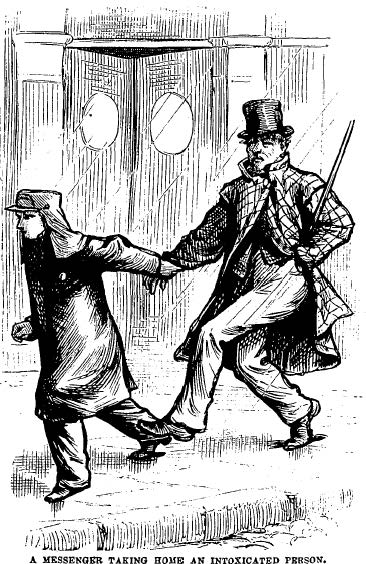
Having survived the catechism, the boys were thrust into the hurly-burly world of the District Telegraph Company’s sub-offices throughout the City, serving as two legged express agents and making $3 to $7 per week. They delivered stock certificates, checks, cash, and ran theater and opera tickets to patrons unable to make it to the box office. On afternoons where inclement weather threatened, District Telegraph boys could be seen rushing about the street delivering messages for customers unwilling to brave the cold. They delivered carpet bags to travelers at the Grand Central Depot. Thanksgiving proved  to be particularly busy, and boys ran newly butchered turkeys all over town. Often, patrons hired out boys and put them in charge of more precious cargo; several of them found themselves escorting young women home from school, or watching over baby carriages while mothers shopped. Wives even sent them after inebriated husbands, and the boys walked the missing men home, for which they received a delivery receipt for “One Drunken Man.”

The Company expanded throughout the country, and every major city had an office. As the telephone caught on, however, the need for the American District Telegraph boys declined, and by the turn of the century the Company turned its efforts towards security services, providing guards and night watchmen for the City’s warehouses. Many of these warehouses were connected to Company headquarters via telephone and telegraph, so that in the event of burglary or fire the police or fire department could be sent to the rescue. By the 1920’s, the American District Telegraph Company started going by its initials, A.D.T., by which name it is still known today.
Check out our other great stories at forgottenstories.net.

Two of our all time favorites:

Goose Races in the Chicago River: https://forgottenstories.net/2012/08/09/come-take-a-gander-at-some-good-ol-fashioned-goose-racing/

Smash a Masher, Pt.2: https://forgottenstories.net/2012/06/12/smash-a-masher-pt-2/
 

Congressmen Behaving Badly

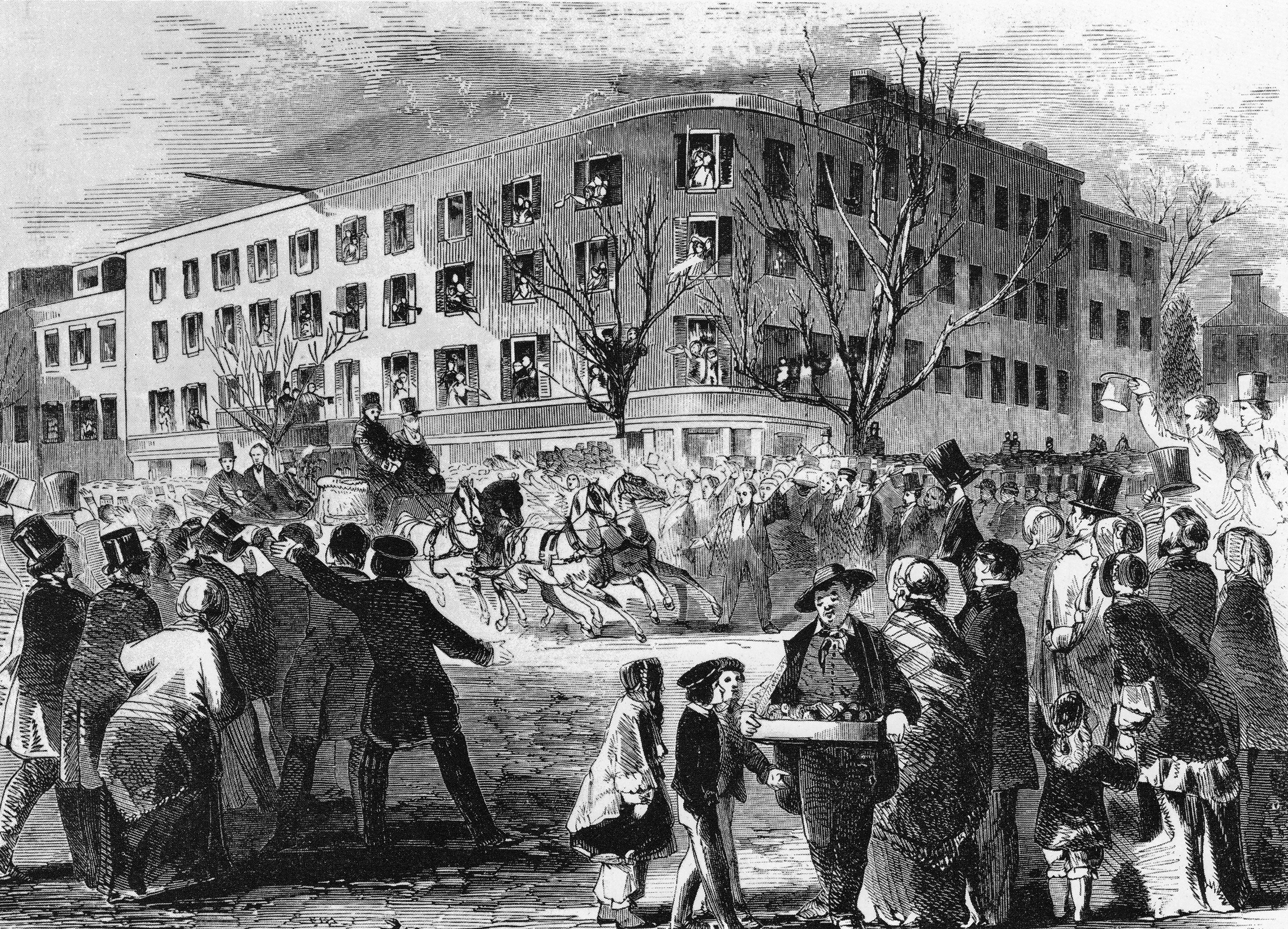
Philemon T. Herbert was a crooked lawyer, a card shark, frequented brothels, and stood accused of attacking a political rival with a knife. In other words, he fit right in with the rough and tumble environment of California in the early 1850’s, so much so that the good voters of that state sent him to Congress as a Representative from the vast Mariposa district south of Sacramento. A native Alabaman, Herbert kept up his carousing with his fellow Southrons once he’d arrived in Washington, and it was with vicious hangovers that he and his friend William Gardiner stumbled into the dining room of Willard’s Hotel at 11 a.m. on the morning of May 8, 1856. Willard’s Hotel (in the background below) was the best hotel that D.C. had to offer.

The dining room was virtually empty. The Dutch Ambassador, Monsieur Devois sat quietly finishing his breakfast, and waiters Jerry Riordin, Thomas Keating, Jerry Quinn, and his brother Charles were polishing glassware and setting the room for dinner.  Herbert growled out an order for breakfast, requesting that Riordin bring him something “damn quick.” One month as a waiter had already given Riordin the ability to size up a difficult customer, and he brought Herbert what he could, telling the Congressman that as per Willard Hotel rules, breakfast was not served after 10:30 a.m., absent special permission from the temperamental French chef, Monsieur Devionese.

Herbert wanted a full breakfast, and he wanted it now. “Clear out you damned Irish son of a bitch,” he told Riordin, who scampered to the kitchen to talk to Devionese and find out if the gentleman from California could be accommodated. Herbert brooked no delay, and ordered Thomas Keating to get him some breakfast.

“I shan’t do it.” Thomas responded, “you already have one boy waiting on you.”

“Go get us some breakfast or go away from here, you damned Irish son of a bitch.” This was more than Keating was willing to stomach. He muttered something under his breath, and now things became truly heated; Herbert stood up and threw his plate at Thomas. Never one to back down from a fight, the 200 pound Irishman responded by throwing a chair in Herbert’s general direction, both of them missed. They charged each other, and grappled in the center of the room.

The waiters stood silently by, watching the fight. Patrick Keating, Thomas’ brother was startled by the sound of breaking crockery, and came charging into the room. He attempted to brain Herbert with a  chair, but instead hit his brother. Gardiner joined the fight, pulling Patrick off and knocking him down with a blow to the jaw, and then freed Herbert by knocking Thomas in the back of the head with a chair. Thomas stumbled, but kept his balance. With his hands finally free, Herbert drew his derringer with his right hand, and grabbed Thomas’ collar with his left.

Placing the gun against Thomas’ chest, the Honorable Congressman Philemon T. Herbert looked into the Irishman’s eyes for a moment, then he pulled the trigger.  The lead shot went straight through Thomas’ lungs, and embedded itself underneath his shoulder blade. A few minutes later, Thomas Keating was dead, having devoted his last breath to call for a member of the clergy.

Herbert voluntarily turned himself in a few hours later. The United States Attorney for the District of Columbia, Philip Barton Key II, requested $10,000 bail, which two friends of Herbert promptly raised. That evening, Herbert, Key and the two friends had dinner together. Even in that day and age, it was unusually for an attorney to have dinner with the man he would be prosecuting for murder, but Key’s moral scruples were only slightly less strident than Herbert’s. The son of Francis Scott Key, and the nephew of Chief Justice Roger Taney, it was political influence which won Key his position as a United States Attorney. Reputedly the handsomest man in Washington, Key was in the throes of a passionate affair with 18-year-old, Teresa Sickles, the wife of Daniel E. Sickles, Representative from New York State.

Out on bail, Herbert returned to Congress, where Ebenezer Knowlton put forward a motion to censure and expel him. Congress that year had been particularly violent. Representative Granger of New York had engaged in fisticuffs with Representative McMullen of Virginia. Horace Greeley, editor of The New York Tribune had been hit  twice over the head with a cane by Representative Rust of Arkansas, but suffered no injuries; the rival New York Herald quipped “Greeley’s head [is] harder than it looks to be.” Most famous of all was the attack on the floor of Congress itself by Preston Brooks on Charles Sumner, which was so severe that it left Sumner crippled. For the expulsion vote, Herbert could count on support from the Know-Nothings, who were anti-Irish, and from Southern Democrats, who wanted Hebert around in case the Presidential election of 1856 devolved upon the House and his vote was needed. The motion was defeated by a majority of nine.

“There is a volume of instruction in that vote,” wrote the Herald, “the men who are in favor of Freedom respect the rights of all, no matter how humble; the men who support Slavery draw a broad line between what are called the upper and lower classes, treading upon those who serve as the would upon dogs.”

Southern papers could not have agreed more. The editor of the Montgomery Mail opined “Mr. Herbert…was attacked by a mob of waiters at his hotel in Washington. He promptly put a bullet through the head waiter, and then surrendered to the authorities. There is no doubt he acted in self defense. It is getting time that hotel waiters a little farther north were convinced that they ARE servants, and not gentlemen in disguise. We hope that this affair will teach them prudence.”

Herbert continued to serve in Congress, and after some diplomatic wrangling resulting from the Dutch Ambassador’s refusal to testify, the trial got belatedly got underway in July. Aided by a sympathetic judge and the less than zealous prosecution led by Key, the first jury couldn’t reach a verdict, and was dismissed. “The influences at work to defeat justice during the first trial of Herbert were so strong and palpable,” stated The Ripley Bee, “and the evidence of the partiality of the Judge toward the prisoner was so positive as to rouse a strong feeling of indignation in Washington.” The Judge and Key ignored popular opinion and a second jury, handpicked by Key to ensure an acquittal, found that the homicide was justified.

He returned to California to seek reelection, but while he’d been away a tide of reform had swept the state. The San Francisco Bulletin reported “the homicide was the observed of all observers yesterday as he went about the streets. People looked at him as they would look at a loathsome monster, out of mere curiosity, and not from any respect or desire to make his acquaintance. He was in company with a lot of well known gamblers all day, from whom he probably meets a warm reception.” The gamblers may have been pleased to see him, but not the citizenry. Thousands of Californians signed a petition requesting that he leave the state; which members of the Vigilance Committee presented to him along with a veiled threat that if he didn’t quit the state, he could be expect to be greeted with a hempen cord by a lynch mob.

Herbert fled south to El Paso, and opened a law practice. At the outbreak of the Civil War, he recruited a cavalry brigade, which he grandly named Herbert’s Battalion of Arizona Calvary. Decimated by two years of war, the battalion was broken up, and Herbert found himself elected to the Confederate Congress in 1863. He resigned in 1864, took up his old rank as Lieutenant Colonel and joined the Seventh Texas Calvary. Wounded during the Battle of Sabine Crossroads, he died in June, 1864.

Be sure to check out the homepage (https://forgottenstories.net/) and our archives for some other great forgotten stories. Some of our favorites:

The Great New York Shoe Conspiracy of 1909: https://forgottenstories.net/2012/05/05/the-vast-new-york-shoe-conspiracy/

Fear Ye the Ducking Stool: https://forgottenstories.net/2012/07/09/fear-ye-the-ducking-stool-ye-common-scolds/

Baby Fever!!!: https://forgottenstories.net/2012/05/20/baby-fever/

Smash a Masher: https://forgottenstories.net/2012/06/09/smash-a-masher/

Adolph Weber, Boy Murderer: https://forgottenstories.net/2012/06/26/adolph-weber-boy-murderer-of-placerville-california/

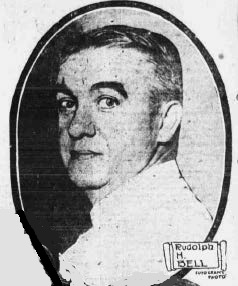
Meet Rudolph H. Bell, Head Chef of the Bronx Zoo

Chefs are, as a general rule, an exceedingly temperamental bunch. Rudolph H. Bell, head Chef of the Bronx Zoo was an exception, and he met his daily task of feeding the Zoo’s animals with good humor. He’d been with the Zoo at the time it was founded in 1899, have taken the job after working in the circus. The animals under his care had ballooned from 4 to 3,262, and many of them were finicky eaters. Bridget, the reigning queen of the chimpanzees, refused to perform her signature trick of posing like an actress unless her rice contained raisins. The two baboons, Jack Dempsey and Babe Ruth, would often throw their meals at observers rather than eat it; Chef Bell only served them food which would do little damage in case it ended up as a projectile rather than dinner. At 300-years-old, Buster the tortoise demanded the privileges of age, and received a daily slice of watermelon.

What the other animals lacked in picky eating they made up for in volume. Judging by his name Peter Murphy was a hippopotamus of Irish extraction; he devoured 6 heads of cabbage, 9 bunches of carrots, 18 loaves of bread, and 36 bananas at a single sitting. Each of the bears received 20 loaves of bread per day, and 5 pounds of beef and 3 pounds of fish per week, and the seals went through barrels of butterfish.

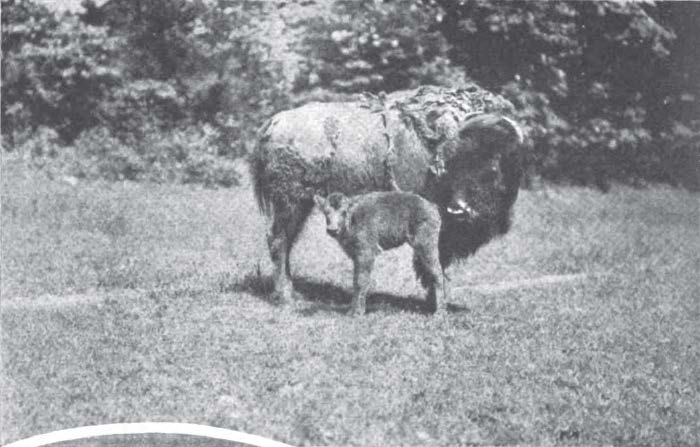
Bell’s efforts weren’t confined to the kitchen, after years of working with animals the Zoo considered him an expert of sorts, to be consulted in unusual situations. Sometime in the 1910s, one of the buffalos gave birth to a rambunctious youngster. In a moment of absent mindedness, Mother Buffalo let Junior wander into a miry spot, and in an effort to extract himself Junior broke his leg. Realizing his predicament, several keepers went inside the pen to render assistance. Doubting the sincerity of their motives, Mother charged the group and the keepers scattered.

They sought the advice of Chef Bell, who concocted a scheme with his assistant, Loring. A former cowboy, Loring entered the pen mounted on a pony, and by fast riding around mother and yelling at the top of his lungs, sought to distract Mother while Bell scrambled to pick up the calf and run to safety. Everything went according to plan until Junior let out a plaintive bleat. When Mother heard it, she charged Bell with her head down. Loring tried to ride between them, but the pony would have none of it, and threw him.  Bell was on his own.

“I looked behind me,” he said, “and saw her coming. Dropping the calf, I made for the fence. But the next thing I knew, I didn’t know anything! Afterward, when I woke up in the hospital, and was strong enough to receive company, they told me how it happened. She picked me up on her horns and tossed me into the air. They say I flew through some tree branches like a bird and landed outside the corral. I had to have an operation then for my injuries; and two years after that I had to have another operation.” Meanwhile, back at the Zoo, the keepers found a solution to the Junior problem. They covered a two-wheeled cart with a box about the size of a piano crate, closed at the top and on the sides, and open at the bottom. Two men got inside and rolled the contraption inside the pen. Mother charged it repeatedly, but could make no impression upon it. The cart was placed over Junior, he was hauled inside, and ten minutes later found himself in the Zoo’s hospital.

Bell eventually returned to his kitchen. In a single day, the Zoo’s denizens consumed 175 loaves of bread, 250 pounds of beef, 15 heads of cabbage, 36 bunches of carrots, 2 barrels of potatoes, 450 bananas, 150 apples, 4 dozen oranges, 15 pounds of boiled rice, 25 quarts of milk, and 500 pounds of hay, not to mention the assorted birdseed, extra seasonal vegetables, the various rodents and insects consumed at the Reptile House, and of course, Buster’s watermelon. To prepare it all, Chef Bell had a gigantic combination kitchen and butcher shop at his disposal, complete with two huge refrigerators, a sink so large one could bath in it, and three big tables at which he and his assistants doled out the animal’s meals. Chef Bell retired in 1935, much beloved by his fellow Zoo employees, and most of the animals; Mother Buffalo was suspected of still bearing a grudge.

No Honor Among Thieves

The night of February 7, 1921 found Al Jennings, whose booking photo is shown below,  in a nostalgic mood as he wandered 25th Street towards Park Avenue. “I had gone down there because I’d been thinking all evening of Bill, and my mind was filled with reveries about him, most of them sad. I was walking along almost feeling that Bill’s spirit would come out and speak to me…”

Jennings’ path to 25th Street was a long one. He and his brothers opened a law practice in Woodward, Oklahoma, a cattle town filled with saloons, brothels, and gambling dens. Attorney Temple Lea Houston (Sam Houston’s son), ignored  the old joke that “a small town cannot afford one lawyer, but any size town can afford two,” and resented the imposition. Houston and the Jennings boys got in a shootout, which left Al’s brother Ed Jennings dead, and wounded John Jennings.

After the Woodward County Court freed Houston on a plea of self defense, Al Jennings fled to the Creek Indian Reservation, where he worked as a cattle hand, but he and his brother Frank quickly became suspected of a number of train robberies. Perception became reality when they joined a band of outlaws in the Arbuckle Mountains in South Central Oklahoma. Al maintained that they’d joined the band of outlaws simply for protection from the law but regardless, Al Jennings was a member of the “Long Riders” who stopped a Rock Island train between Minco and Chickahsa in October, 1897. Their target was $100,000 in U.S. Army payroll, but the nitroglycerine with which they’d intended to blow the safe failed to go off. Taking what they could from the passengers, they fled. A friend betrayed his hideout, and a posse captured him at the Spike S ranch. The court sentenced him to life imprisonment, which he served at the Ohio State Penitentiary.

Here he met Bill, the man he’d been thinking of on that winter’s evening in 1921. Bill was serving a five year sentence for embezzlement from an Austin, Texas bank, and the two became fast friends, always ready to share a laugh at the expense of the guard assigned to the hospital wing where they worked, Orrin Henry. Bill was released in 1901 for good behavior, and Al Jennings followed him in 1903, released on a technicality after strident legal efforts by his brother Ed. In 1907, Theodore Roosevelt himself issued Al a full pardon, wiping his slate clean.

Bill and Al met up in New York City, trading drinks at Pete’s Tavern in Gramercy Park, and generally having a good time. Perhaps they lived it up a bit too much. Bill was an alcoholic; his wife left him in 1909 after he failed to give up the bottle, and he died in 1910 of cirrhosis of the liver and an enlarged heart. Al went back to Oklahoma, served as an advisor on a silent film detailing robberies in the Old West, and unsuccessfully ran for sheriff and governor, and wrote his autobiography, and became pretty famous. In 1921, he returned to New York City to revisit some of his old haunts.

It was during this trip down Memory Lane and 25th Street that Al was held up. “He was a big guy, kind of foreign-looking, with an accent of some sort” Al later unhelpfully described him to police. With a gun in his ribs, Al dutifully raised his arms and remonstrated, “Listen, pal,” Al said, “You don’t want to hold me up.”

“Shut yer trap and come across with what you’ve got.”

“But I’m Al Jennings.” The name meant nothing to the bandit.

“Yeh, I’m Bill Bryan.” The now duly introduced stick up man proceeded to loot Jennings of wallet, diamond stick pin, and $82.00.

“I felt positively afraid for my life, like a rabbit coming out of the mesquite. I was sure my lights were going to be put out, and I thought of my Airedale dog and the rest of the family out home. I even saw myself lying cold and stiff in the morgue.” He made one last attempt to reason with the bandit.

“Wait a minute old timer. All I’ve got left is a dime. You wouldn’t leave a pal stranded with only a dime, would you? I’ve got to have carfare home.” Playing on sympathy didn’t help.

“Aw, shut up. So’ve I, and this only gives me enough to get where I’m going. You can have the dime though.” The bandit took off, leaving Al with his dime and his thoughts. His opinion of New York’s criminal element was none too kindly “The man who robbed me was coarse and uncouth. When we used to rob out in Oklahoma we used to make ‘em feel comfortable, but this man made me feel ill at ease. He was not only rough, but insulting.”

“I’m not kicking about his taking my money – $82 and my pin, but I would like to have back the pardon which President Roosevelt gave me. You know, I think a lot of that. The old Colonel isn’t here anymore to sign his name. If that guy has the principle of a cootie he’ll send that back to me.”

Al knew at least one man would have gotten a laugh out of the great train robber being held up and left with a thin dime, his old friend Bill, full name William Preston. Bill had written short stories under a pen name, taken either from their guard at the hospital wing, Orrin Henry, or from the various letters of Ohio State Penitentiary.

“O. Henry would have thought this a good joke on me” Jennings chuckled when interviewed by the New York World, “Maybe it is, but I’m not going out nights alone after this.”

Looking for a Red Ear

We have no doubt the readership has husked corn before, six ears or so preparatory to having corn on the cob for dinner, and found it an easy task. When you have an entire corn harvest, which must be husked before it can be ground into corn meal, the task must have seemed particularly daunting to your average farmer, but he had a ready-made solution steeped in American tradition. After the corn had been harvested sometime between the middle of August and early September, depending on the rains, he piled the whole of it into his barn, and sent invitations around to the young men and women of the neighborhood, inviting them to a corn-husking frolic.

Now, merely attaching the word “frolic” to a particularly mundane task smacks of Tom Sawyer and his whitewash, and so the farmer and his family provided some inducements. There was an elaborate feast; often a whole roast pig, fresh bread, venison, chicken and a whole host of pies for desert. The corn husking frolic provided the chance to mingle with the opposite sex, which was no doubt relished by farmer’s son’s who’d just spent the entire spring and summer on a plow looking at nothing more attractive than the rear end of a mule. The suntanned women of the plains no doubt appreciated the chance to get out of the kitchen, and the opportunity to mingle and show off a new dress.

There was one final inducement. As they husked, and as the piles of yellow corn grew larger, the young men kept a lookout for a mutation, a red ear of corn. Not quite as hard as searching for a needle in a haystack, but only one or two of the ears out of the gigantic pile would be red. It was however the true prize, because the man who found a red ear of corn got to kiss a girl of his choosing. The caption accompanying our picture states:

What laughing and talking and romping, as the dry leaves were plucked from the ear! What expectations in female bosoms, as the false alarm of “Red Husk” would be cried when some knight, not an Apollo, lucked an ear that was a little tinged. What sly jokes went about as to which of the girls the lucky finder would kiss, that being his free full right and privilege; and when at length the talisman was found, what a shout of triumph from the discovery, and what a trepidation and giggling amongst the girls! Our illustration represents a husking party at the moment when the red husk has been unearthed. The gentleman is about to not only claim, but to enforce, his privilege, and, from the expression in the lady’s face, it is not improbable that she fully expected this mark of esteem should the husk be found by this particular cavalier.

A Forgotten Stories Buffet

Often when we here at Forgotten Stories have finished a story, and laid our weary head down to rest, there are leftovers that didn’t quite seem to fit, or illustrations that were interesting, but a whole column couldn’t be fashioned around them. So here we present a Forgotten Stories smorgasbord (by the way, smörgåsbord didn’t enter the American lexicon until 1939, when it was a featured entrée at the Swedish pavilion at the World’s Fair.)

First on the menu, some delightful humor from June 9, 1866, just as New York City was meeting a zebra for the first time:

This particular item probably should have found a home in our posts on bicycles, but unfortunately turned up too late to be used. On June 7, 1868, during a Spanish bullfight, a creative picador replaced his horse with a bicycle; explaining that as bicycles didn’t tend to get disemboweled  by an irate bull, the choice was a logical one. To the bull it made no difference, he knocked over the picador, who found safety in flight, leaving his bicycle behind.

On May 27, 1871, the Pittston Coal Mine collapsed in a heap of rubble and fire. Trapped at the bottom of the mine was a minor miner, little Martin Creghan, and some of the more mature members of the mining fraternity, including his older brother. To protect themselves from the rapidly approaching flames and noxious fumes, the miners set to work raising a barricade. It was almost done before they realized that some sort of message should appear on the outside, letting their rescuers know that men were trapped inside. Only Martin could fit through the remaining hole. With a piece of chalk, he used his limited schooling to scrawl, very slowly “We are all in here.” Then, perhaps sensing his own impending doom, Creghan ignored the entreaties of the miners, who were quite anxious to seal the barricade, and laboriously wrote his name in full. They barely managed to pull him inside before the fire arrived. The men were eventually rescued by their fellows, who noted Martin’s sign; but unfortunately help arrived too late for Little Martin.

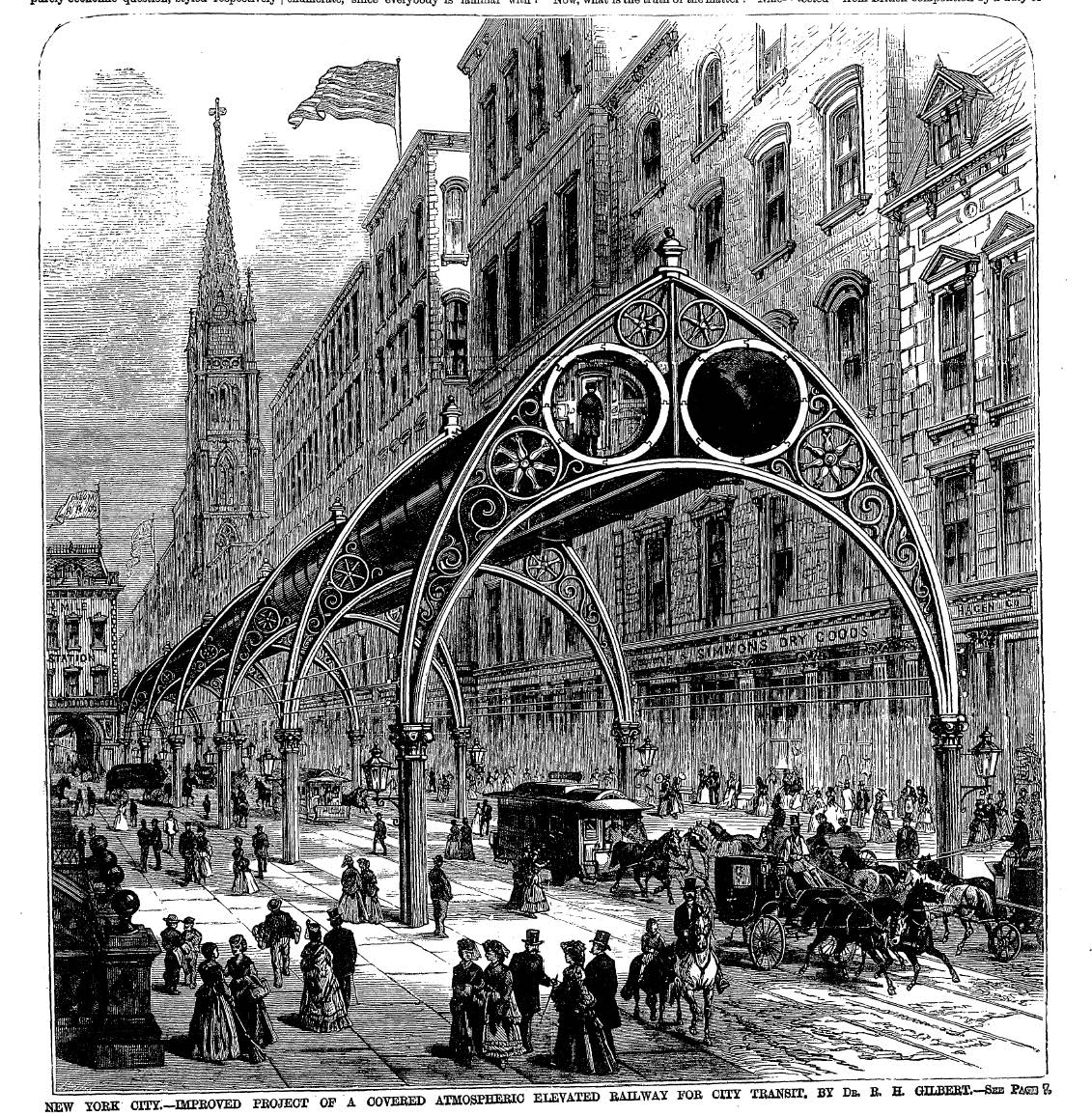
We’ll finish our tour with a dessert. You may have heard of pneumatic railways, where the cars are pushed along with giant fans. There was an underground one for a brief time in New York City; and illustrations of it were used for the Subway chain of restaurants for years, you can still find them on the walls of a few of them. Our forbearers weren’t merely thinking underground pneumatic transportation, for it would be far easier and cheaper to build the whole thing above ground, So here we present the original idea for New York Elevated Transit (note what appears to be Trinity Church in the background):

For those who want an exhaustive history of the underground pneumatic propulsion project, check out: http://www.damninteresting.com/the-remarkable-pneumatic-people-mover/

The Colossus of Roads

“Bicycle riding is a good, healthy and invigorating exercise, and is especially valuable to those whose lives are sedentary. Boating, baseball and lawn-tennis are all excellent forms of recreation; but in the wide complexity of modern life there is plenty of room for the wheelman with his graceful iron steed.” – New York Tribune, September 21, 1883.

By 1883, the bicycle craze was already well underway. The velocipede had been introduced into this country in 1869, but had met with miserable failure, doomed by a combination of lack of comfort and horrible roads.

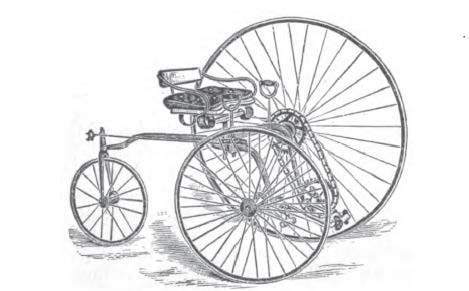
Over in Europe however, the evolution of the bicycle continued, and in the Summer of 1877, Colonel  Albert A. Pope of the Pope Manufacturing Company saw his first bicycle; imported by an English visitor to Newton, Massachusetts. At the time, there were a handful of bicycles in the United States, imported from England, and Pope saw big things in the bicycle. He was off to England on the next boat to learn how the things were made, and in early 1878, the Pope Manufacturing Company began turning out three models of bicycles; the Standard Columbia, the Special Columbia, and the Mustang; the latter designed for the younger bicyclist. For the safety conscious, the Pope Manufacturing Company also turned out the Columbia Tricycle.

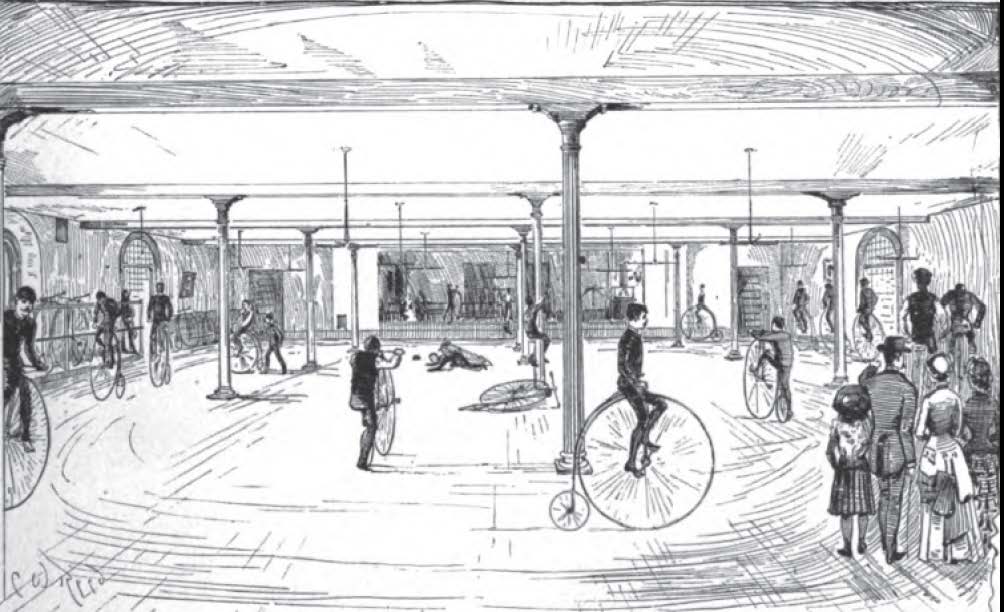
Barely anyone knew how to ride the dang things, and so Pope set up a riding academy at the company’s corporate headquarters at 87 Summer Street, Boston.

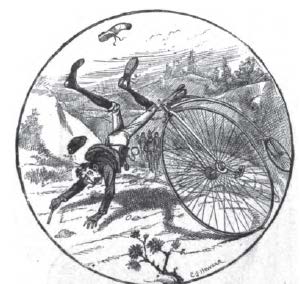
Demand soon became insatiable, nor was it restricted to men; word trickled back that a daring “aristocratic lady bicycler” and a coterie of companions were enjoying the City’s pleasant streets. Nor were the streets particularly smooth, spills happened regularly.

Pope’s  took over the Weed Sewing Machine Company’s manufacturing buildings outside of Hartford, Connecticut. It became the biggest bicycle company in the world, turning out 50 machines per day, and the company imported leather, iron, steel, and horn in vast quantities.

Pope subdivided the factory into separate rooms. In one, blacksmiths worked pouring metal into specially crafted dies to form the forks which would attached the frame to the wheel; in the “perch shop,” the tubular backbones of the bicycles were bent into shape; and in other rooms the wheels were rolled out, the seats crafted, and the various and sundry parts of the bicycles were welded and lathed. Put together, the bicycles were inspected, and then sent off to yet another room, to be nickel plated and thus protected from corrosion. By the count of one visitor, it took 158 machines to make the 77 parts which went into the Standard Columbia.

Their riders loved their new contraptions, some even wrote poetry about them; bad poetry, but poetry nonetheless. Here’s a typical example by N.P. Tyler from 1879.

There were accessories too, including the first domestically manufactured cyclometer, which would tell the rider exactly how far he’d gone. Indeed, they began to roam far and wide over the countryside; to race each other in long and short distance races; and to try their skill at “no hands” competitions, all of which exciting details we here at Forgotten Stories will be describing over the next few days, so stayed tuned.

Adolph Weber, Boy Murderer of Auburn, California

On the night of November 10, 1904, Julius Weber presided over the family meal as he’d done countless time before. His nineteen year old son Adolph had been absent, but that was nothing out of the ordinary; for the past year or so, “Dolphy” as his parents called him, had taken his meals in his room. Adolph’s typically morose demeanor left his mother Mary Weber guiltily grateful that the young man hadn’t joined them.

Up until a few years before, Dolphy had been the family’s pride. His sister Bertha adored him. Dolphy took special care of Earl; who was what doctors of the day called an imbecile. Now, Dolphy was nothing but trouble to his family. He became morose, and dressed all in black. Rumors circulated of a shed in the back of the family’s homestead where he performed cruel experiments on small animals. He began raising fighting cocks, and if they lacked the martial spirit, he trample their heads with his boots, grinding their skull beneath his heel. The entire populace had talked for weeks on end when a desperado robbed the Placer County Bank in early 1904; Adolph didn’t care, and snapped at anyone who asked his opinion about it.

Dolphy disappeared for a few days at a time, his family circulated that he was visiting friends in Sacramento or San Francisco; and they weren’t technically lying, if one called the prostitutes which inhabited the low brothels in those towns “friends.” He’d been seen striking Earl, impatient at the amount of care the mentally deficient boy needed. The family doctor, Robert F. Rooney became firmly convinced that Dolphy was a hypochondriac; even worse, he diagnosed the teenager as a chronic masturbator. Dolphy approached Rooney to request a circumcision to cure the malady, his family had caught him one too many times. The doctor refused to perform such a procedure on a sixteen year old absent parental permission; Adolph reluctantly returned the next day with his father, who’d consented to the operation which was duly performed.

With the morose Dolphy upstairs, daughter Bertha, aged 17, and Earl, aged 12, completed the family circle at the dinner table that mid-November evening. Earl sat close by his mother’s side; his handicap meant that a member of the family needed to be in constant attendance.

Although he’d been in America for some thirty years, Julius’ German accent was still heavy, but the town of Auburn was a welcoming place,  and besides, they’d expected the former owner of the town brewery to be a German; all good brewers were. The family’s meal that night was probably German too, washed down with good beer. At 6:30 in the evening, the heavy food settled in his stomach, Julius tucked a copy of The Placerville Mountain Democrat under his arm and closed the bathroom door behind him.

His son Dolphy burst in while Julius’ pants were still around his ankle. Adolph leveled a .32 caliber pistol at his father’s chest, and wordlessly pulled the trigger; the bullet entered his father’s heart killing him instantly.

Adolph strode into the living room, where his mother, Bertha and Earl were talking. One shot felled his sister, and his mother and Earl ran screaming to the entrance hall. Adolph’s first shot into his mother’s back, knocking her to the ground.

She rose, scrambling to reach the telephone. She managed to pick up the receiver before Adolph shot her in the head; bits of brain and bone covered the rotary dial. Adolph didn’t even waste a bullet on little Earl; he crushed the child’s skull underneath the butt of his gun.

Each of the bodies was dragged to the living room and Adolph set the house afire to cover the crime.  He walked out the front door on his way to town as the fire smoldered behind him.

In his hurry to leave, Adolph hadn’t had time to examine his clothes, under the streetlights which illuminated Placerville’s miniscule business district, he noticed several bloodstains. Fortunately, the general store was still open. He ducked in and purchased a pair of pants that were a few sizes too small; when [the clerk] offered to sell him a pair more suited, Adolph angrily remarked that he was in a rush to get to a social engagement, and that he’d ruined his previous pair by running into a fire hydrant.

With his old pants rolled under his arm, Adolph was strolling down Main Street when the fire bells rang out. Along with most of Auburn’s population, Adolph ran to the Weber household; the fire was already fairly well underway. Several witnesses saw him break the window glass with his old pants, and throw them on the flames. Rescuers managed to carry little Earl’s body outside, wrapped in the curtains which had been [Wife’s] pride. Adolph’s blow with the gun hadn’t killed the boy, but he expired a few moments later on the front lawn.  Other neighbors managed to drag the family piano, an elaborate model costing $9000, out on the front lawn; the rest of the house burned to the ground.

Initially it appeared that Adolph was to be pitied; his entire family had burned to death in a house fire, and the poor orphan was now all alone. Then the police discovered that the charred corpses had been shot. Mrs. Snowden, Adolph’s aunt, told a newspaper that Mary feared her son’s temper. Adolph was confined, then formally booked for first degree murder charges when the coroner’s jury heard the facts. The pants with which he’d broken the window were found to contain blood stains. Yet, Adolph still had his supporters; even after the police discovered the $20 gold pieces taken from the Placer County Bank robbery hidden under a pile of manure in the barn, female admirers still sent violets to the jail.

The trial stretched over several days, Adolph continued to maintain his innocence even as the prosecution tore his alibi apart. With $70,000 inherited from his father, Adolph fielded the best defense team money could by, headed by Ben Tabor, a one-armed attorney who’d become legendary for his legal skills in the rough and tumble world of late 1800’s California. Tabor’s best efforts proved of no avail; Adolph received the death penalty.

In 1906, Adolph strode up the 13 steps to the waiting platform at San Quentin Prison. He said nary a word as the hangman placed a black hood around his neck and fitted the noose around his neck. The trap sprung, Adolph made a few twitches and then hung silently.

After Adolph’s trial, California adopted a parricide law; no longer would persons accused of murdering their parents be able to inherit; until after they’d been found innocent.

Smash a Masher, the thrilling conclusion

“I had stopped for a moment to look at a poster in front of a moving picture place,” said Alice Stebbins Wells, “when a man came up and ingratiatingly asked me if I did not want to see the show, offering to take me. Now, I can readily imagine that if I had been a poor young girl without a nickel, and worse yet, with the knowledge that I never would have a nickel to spare for such a treat, I might have accepted the man’s offer and so possibly have taken the first step to ruin.” Miss Wells was made of sterner stuff; she had to be, for not only was she the first policewoman in Los Angeles, she was the first policewoman in the country.

Women had worked for the LAPD before; mostly as “matrons” in penal institutions where they supervised female prisoners or wards of the state, but in 1910, when the Los Angeles City Council gave Miss Wells her badge and provided her with arrest powers, it marked a departure from decades of tradition. Most of Los Angeles did not note the change that was afoot; according to the Los Angeles Almanac, LAPD officers enjoyed the privilege of free trolley rides to and from work; when Miss Wells displayed her badge, the conductor accused her of pilfering her husband’s badge to cadge a free trip. The Department remedied this problem by presenting her with a special badge, “Policewoman’s Badge Number One.”

Throughout the country, cities followed Los Angeles’ example, and by 1915 there were enough policewomen for Wells to organize the International Policewomen’s Association. These women’s experience varied, Philadelphia’s policewomen were stationed in the City’s train station; fluent in six languages they acted more like social guardians than Cagney and Lacey; steering young and confused immigrant women away from vice ridden hotels and into safe boardinghouses. Back in Los Angeles, Wells remained busy stamping out vice; in particular she frequented dance halls to make sure they didn’t operate as brothels.

New York City hired Miss Ruth Crawford as its first policewoman. A wealthy heiress and Vassar graduate, joined the NYPD briefly after earning her Master’s in Social Work from Washington University in St. Louis. Although she soon left to join the YWCA, hundreds of women would follow her footsteps and join New York’s finest.

Chicago decided to go one better and hired an entire police contingent composed of females. History preserves their names, Miss Alice Clements, Miss Lulu Parks, Miss Margaret F. Butler, Mrs. Madge Wilson, Mrs. F. Woodman-Willsey, Miss Clara Olsen, Mrs. Anna Louckes, and Miss Anna Neukom. Assigned to the Detective Bureau, Clements and Parks were welcomed by their Captain “They are made of the right material, “he said, “and I believe this new move is a good thing for the department. Chicago should have twenty-five more policewomen.”

Lulu Parks was dispatched to New York City to arrange the capture and extradition of a former waitress who’d stolen $250 from her employer; dressed to the nines in a dark blue tailormade walking suit, gray coat and black velvet hat, trimmed with a black plume, and topped with a green feather, she caught her quarry unawares, and the thief was on her way back to Chicago. Parks admitted she’d carried two revolvers on the job; but refused to disclose where on her person she’d concealed them.

The others were assigned to smash the mashers, and they strolled in plainclothes up and down Wabash Avenue.

“So we started out first to clear the city of mashers,” said one. “I will not forget my first arrest of one of this species. It was my second day on the force and I was a bit timid, having made no arrest so far. I passed this youth – a big, overgrown boy. He bowed, and called me an endearing name and tried to grab my arm. My face reddened and my anger almost overpowered me.

‘You’re under arrest.’ I shouted at him as I displayed my star.

‘You wouldn’t arrest me, would you cutie?’ He said as he tried to wrench away. Angered by this latest insult I drew my revolver and hissed:

‘You either go to the station or to the Cook County Hospital.’ He subsided, and I took him to the box and locked him up. Next day he was fined $10.”

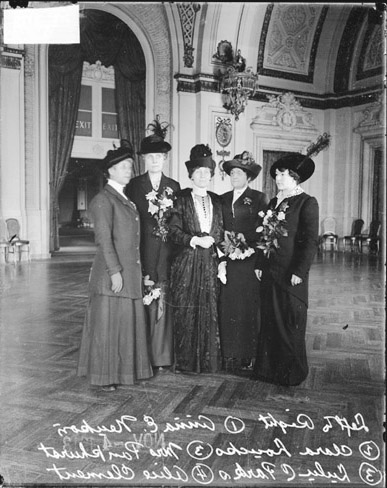
British Suffragette Mrs. Emmeline Pankhurst (center) with policewomen (from left to right) Anna E. Neukon, Clara Louckes, LuLu C. Parks, and Mrs. Alice Clement; in Chicago’s Hotel LaSalle. Wish LuLu was wearing her hat. From the Library of Congres

Smash a Masher, pt. 2

One of the mashers’ favorite tactics was to approach a woman from behind. One such masher was  William T. Gobrecht, age 24, married, and father of a two year old specialized in pilfering stationary from hotels such as the Congress, writing letters proposing intimate rendezvous, and dropping them in the laps of ladies on the El. Gobrecht was eventually caught, but the “approach from behind” method led to the development of protective headgear, complete with reflecting mirror.

One didn’t necessarily need a bonnet for protection. Mrs. Elena DeHart of 949 Amsterdam Avenue, widow of a New York dentist, wanted to go about New York City unmolested, so she armed herself with a shillelagh;  a piece of rubber hose ten inches long which she could loop around her wrist. Mrs. DeHart’s had her own special tactic; “I always hit behind the ear because that is the centre of the nerves and it knocks him silly. The victim turns round and round in a dizzy whirl and is so stunned that I can sit on him if necessary until I get a policeman.” Once the policeman arrived, Mrs. DeHart swore out a complaint, and the bums were jailed. Some 50 mashers were convicted on her complaint. Mrs. DeHart taught herself jiu-jitsu because the police kept confiscating her shillelagh.

There were a few women who took advantage of the “smash a masher” craze for their own financial  aggrandizement. Clarence Cullen, formerly a house detective at a fancy New York Hotel, described how one petite brunette worked her scheme. According to Cullen, her first step was an outfit that would catch the eye with “dresses that barely reached the shoe tops;” scandalously short to entice gentlemen hoping for a glimpse of a bit of ankle. “Then she would pick out some emerging male who looked pretty soft meat. She had a keen eye for portly men of the good natured looking type, men with vacillating mouths, men who looked easy to stampede.”

Selection made, the brunette would approach and ask for directions, to gain the attention to the victim and make him stop. Then, looking him straight in the eye, she would say something along the lines of, “’You have stopped me and insulted me. You are a masher. If you don’t give me twenty-five dollars I shall have you arrested…on the charge of mashing…If you don’t give me twenty five dollars instantly, I shall scream, and faint, and you will be arrested.”

After making a quite a nice pile for herself, the young lady was arrested and sent to Blackwell’s Island.