Smash a Masher

We here at Forgotten Stories are known for being a trifle dense when it comes to the travails of being a woman. As gentlemen of the old school (at least we think we are), we aren’t particularly aware of what the modern woman calls a “creeper.”

But, we were struck the other day by the tale of a young lady of our acquaintance who, in great and exhaustive detail, reviewed the efforts of creepers to get her attention. Another young lady described how, when walking the streets of New York, she listened to her IPhone and wore sunglasses to avoid hearing catcalls and making eye contact. So we did a little digging, and there is nothing new under the sun. Our grandmothers were tormented in the 1940’s by their version of creepers “wolves,” and our great great grandmothers of the early 1900’s had their own tormenters, “mashers.”  Our illustrious forbearers fought back against the mashers, and over the next few days we’ll be detailing their efforts.

Here is Miss Ann Tracy, niece of J.P. Morgan. After she was accosted one too many times with “Aren’t you lonesome little girl?” she started bringing her German Shephard, Luchs, with her everywhere she went. 

When a pestiferous masher groped Tracy in Central Park, Luchs was let off the leash, and a masher was tree’d until police help arrived. A press photographer caught the whole thing on camera.

Not everyone could afford protection like Luchs, and several women took matters into their own hands. Elizabeth Mayne, a San Francisco show-girl in 1911, received a particularly vulgar note from a Dr. Weiss. Mayne reported the matter to the police. Setting up a sting, she agreed to meet Weiss on the street corner, and he was nabbed by an undercover police officer when he approached. It wasn’t because it was a mash note,” explained Miss Mayne, “that I had him arrested. We get lots of mash notes. Some are amusing, some silly, and some pathetic, but this one was entirely too vulgar and that’s why I had him arrested.”

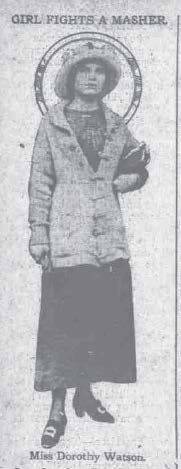
Dorothy Watson had her own run in with an E.J. Simpson, a masher in Los Angeles in 1912. “I had just come of watch at the telephone office and stepped into the doorway to adjust a garment. Simpson approached me as I came out and insulted me. I spurned him, and he attacked me, blackened my eye and hit me on the side of the head. I didn’t see anyone to protect me, so I protected myself.” Watson started beating Simpson over the head with her handbag, and when he ran away she chased him down. Once she found out where he’d hid, she called an officer. Simpson was arrested and convicted, although the sentence is unknown.
The judges of the day weren’t enthused at the verbal affronts to the women of their cities. Judge Charles E. Foster (shown here)  of Omaha, Nebraska had a “masher schedule.”

According to the judge “For calling a girl ‘a chicken’ the fine will be $5; ‘honey bunch,’ $10; ‘turtle dove,’ $15; ‘baby doll,’ $20, and woe unto the master that addresses any girl as Little Cutie.’ I’ll give him the limit, $25.”

Foster was true to his word. Masher J.T. Sullivan approached a young woman and called her “some cute chicken.” She responded with several well placed jabs with her hat pin, before Sullivan was arrested by an police officer who’d heard the whole thing. “I don’t care who you are or who your father is.” said Judge Foster “The officer heard you call the girl a ‘chicken.’ She punished you some, and I am going to let you off with a fine of $5.” Sullivan was lodged in jail until he could raise the $5.

More masher smashing to come, so stay tuned!


Follow Up:

Smash a Masher pt. 2  – https://forgottenstories.net/2012/06/12/smash-a-masher-pt-2/

and pt. 3 – https://forgottenstories.net/2012/06/18/smash-a-masher-the-thrilling-conclusion/

Madame Moustache

She went by many names; Simone Jules, Emiliene Dumont, Eleanore Dumont, Sara Da Valliere, but most commonly, Madame Moustache. She arrived in San Francisco in 1850, her French accent gave credence to her story. She claimed to be the daughter of a French Viscount who’d returned to the South of France after Napoleon’s fall to find his estate and finances in ruins. To restore the family fortune, the Viscount arranged a marriage to an overbearing husband for his only daughter; after an affair with a Lieutenant ended in her virtual imprisonment in a French chateau, she contrived to escape, and after a series of adventures which she never disclosed, found herself in California. Her moustache not as of yet having arrived on the scene, she presented herself as Emiliene Dumont.

Dumont took a job dealing cards at the Bella Union; there was good money to be had at her favorite game, Vingt-et-un, otherwise known as 21. By 1854, she’d raised enough to open her own gambling house in Nevada City, California. Dumont’s gambling parlor was filled with fine furniture, and offered rare and choice wines and liqueurs. Dumont fell in love with E.G. Waite, editor of the Nevada Journal; when she refused his affections she turned to alcohol. Broken hearted, Dumont fell prey to an employee, Lucky Dave Tobin. He was no gentleman; he beat her and tried to take over the gambling parlor. She eventually came to her senses, fired him, sold the business, and decamped to Virginia City, Nevada.

Over the next few years, Dumont rarely stayed long in one place, moving from boom town to boom town. One friend described her as “a small woman, one of the kind who would be called little, with a form almost perfect and with a grace of movement rarely equaled. Her complexion was strongly brunette, her hair being jet back, and her eyes, though large, as is common with the women of southern France, were wholly lacking in that dreamy expression associated with the daughters of the south, both on the contrary were sparkling in their jetty blackness.” She was known to buy the men who lost heavily at her table a glass of milk when they’d run out of funds.

At her gambling parlor in Banneck, Montana, she earned the sobriquet “Moustache Madame” from a disgruntled miner who’d lost his temper and a bundle at her table.

The  nickname stuck, but it didn’t prevent Jack McKnight, a cattleman, from trying to win Dumont’s affections. He succeeded, and with the Moustache Madame’s capital, two bought a cattle ranch outside of Carson City, Nevada. McKnight didn’t stick around very long, a few months after the purchase, McKnight was gone, after cleaning out Dumont’s bank account and taking all her jewelry. To top it all off, McKnight had sold the ranch too.

Western legend has it that when McKnight was found a few weeks later filled with bullets from a double barreled shotgun, the local sheriff didn’t investigate too closely.

But the Moustache Madame was now penniless and she’d begun to drink heavily, dulling the senses which had earned her so much during the Belle Union days. The lovely petite brunette of the 1850’s had turned into a dowdy dowager, the mustache had gotten darker, and now it was no longer her good looks that brought men to her card table. Rather, they came because of the Madame’s reputation and for her penchant for honesty; she never failed to pay off when she lost.

Rather, they came because of the Madame’s reputation and for her penchant for honesty; she never failed to pay off when she lost, until her arrival in Bodie, California. Her financial stores exhausted, Madame Moustache borrowed $300 from a friend to stake her in a card game. It lasted only a few hours. Despondent, Madame Moustache wandered into the desert. Amongst the sagebrush and the lonely howls of the coyote, the Madame ingested a bottle of morphine and went to her death alone.

Her body was found the next morning by a sheep herder, and her funeral was attended by friends from as far away as Carson City. Her grave still stands in Bodie, California.

UPDATE**** Courtesy of Philippe Nieto, photographer extraordinaire, we have a picture of the hearse that carried the good Madame to the Bodie cemetery.   Thanks Phil!

The Tokio Fire Department’s Annual Drill

Tokio (for so it was spelled by Westerners until the early 20th Century) was a disaster waiting to happen. Some 40,000 buildings were made of paper and wood, and the slightest spark could set the whole city ablaze; indeed, some 15,000 buildings burned to the ground in a conflagration in the middle of the 1800’s. A town with such fire danger demanded a well trained fire department, and Tokio had it. Fire drills, such as the one shown here, showcased their skill and were well attended by the population. According to Frank Leslie’s Illustrated Newspaper, which sketched the drill in 1884, “the occasions upon which the Tokio Fire Brigade turns out for drill are red-letter days for the almond-eyed inhabitants of that city, who assemble to witness the vaulting ambition of the nimble and acrobatic members of the force….going through a series of evolutions connected with ladders – evolutions more like the feats of acrobats in a circus than the drill of responsible firemen.” In addition to ladder acrobatics, the Tokio firemen were specially trained to rescue furniture from the blaze; with prizes and plaudits awarded those who could lower a chair, table, or other household good deftly down the ladders without any unnecessary damage.


Pesky Pedestrians Pose Plentiful Problems

Sixty-two companies were building horseless carriages in 1906, from the National Sewing Machine Company of Belvidere, Illinois, the White Sewing Machine Company of Cleveland,  to Cadillac, Locomobile, Jackson, Moon, the St. Louis Motor Carriage Company, and the Eisenhuth Horseless Vehicle Company, whose Compound Model 4 featured an innovative three cylinder motor. In 1906, a Ford Model T could get up to 45 mph, and a Stanley Steamer topped out in the high 30’s. These newfangled contraptions bred trouble for pedestrians, and had ever since Henry Bliss became the first automobile fatality in 1899.

Fortunately for the victims of the speeding motorist (called a “scorcher” in the parlance of the times), a nameless English inventor came to the rescue, and just fastened a cowcatcher, such as those that used to exist on steam trains, to the front of his car. The cowcatcher, padded and furnished with strong springs, so as not to damage the car, simply pushed those pesky pedestrians right out of the way.

Meet Stubby, decorated soldier of WWI

John Conroy met his best friend, Stubby, while an undergraduate at Yale in 1916. Despite the fact that Stubby was not yet 18, and thus ineligible for the American army, Conroy smuggled Stubby aboard the transport SS Minnesota when the 26th “Yankee” Division set out for France. Although Conroy’s commanding officer wanted to ship Stubby stateside, Stubby had learned a modified salute, and the hardnosed CO was so charmed he let Stubby say.

The Yankee Division served in four separate offensives, and Stubby, while still not officially a member of the U.S. Army, took shrapnel from a German grenade in the leg, and survived a German gas attack. Stubby became so adept at knowing when German gas shells were incoming, that during an early morning attack while doing sentry duty, he successfully roused the men of the Division from their deep slumber, saving many a life. Stubby even took down a German spy, earning a promotion to Sergeant. All told, Stubby saw 17 battles .

Returning stateside, Stubby was given a hero’s welcome, meeting President Woodrow Wilson. His military service done, Stubby volunteered for many causes, but especially took to heart his work with the Humane Society.

Here’s a picture of Stubby, wearing his many decorations:

Oh, and while Conroy was studying law as Georgetown, Stubby served as the Hoya. He met Presidents Harding and Coolidge, and passed away in 1926. If you want to meet Stubby, his remains currently reside at the Smithsonian.

Charles Myrick, Company A, 8th Regiment, Maine Volunteers

It being Memorial Day Weekend, we are reminded of all who gave their lives in the armed services of the United States.  Not all of these deaths were combat related; experts tell us that 414,152 perished from disease during the Civil War (twice as many as from battle).  Forgotten Stories is dedicated to discovering the individuals behind the numbers, and in honor of Memorial Day, we present you with the death and funeral of one of these 414,152 men; Charles Myrick of Maine.  Although we usually edit articles from the past for brevity (our forbearers were incredibly long-winded), today we present the article from Frank Leslie’s of February 7, 1863 in full:

Imagine a crowded transport steamer, homeward bound from the war, with her human freight of sick and wounded, of officers returning on leave for a brief respite from Southern miasma and camp toil, of poor, enfeebled men dragging themselves home to die.

The lamps are lit in the long upper saloon.  Though the vessel heaves and strains in the wild, angry sea, they shine pleasantly on the little groups which surround the card-tables, gather round some veteran story teller, or chat eagerly as they anticipate, in imagination, their safe arrival and welcome home.  All seems bright and cheerful.  There is a little stir, a sudden interruption; a poor soldier, himself an invalid, as his sunken cheeks and hollow yet brilliant eyes but too clearly indicate, enters and asks eagerly for a physician – his comrade is dying.  A little party, of whom the writer is one, detach themselves from the light and noisy gaiety of the comfortable upper cabin and go down into the hold, which has been roughly fitted up for human habitation.  It reeks with smells; it is dimly lighted by swinging lanterns, which rock to and from, keeping time, pendulum-like, to the roll of the sea.

The sounds which salute the ear are in keeping with the scene.  Here a smothered groan, an impatient murmur, a weary sigh, the heavy monotonous clang of the ever-moving machinery, mingle strangely with the dull swash of the waves as they glide by, or break angrily beneath our counter, making mournful music.  The man leads us on to the darkest dreariest corner.  He pauses by a miserable bunk, where, upon a blanket, with his knapsack for a pillow, lies something that, in the dim, uncertain light, takes human shape and form. “Bring a lantern here,” says the doctor.  A light, which had hitherto hung against a distant bulkhead, is brought.  It reveals a filthy, foul-smelling resting-place, upon which lies stretched a young soldier, yet in the agonies of dissolution.  The rattle is already in his throat.  I take the cold hand in mind, the pulse just flutters – that is all – the extremities are already chill in death.  He swallows a little stimulant, but the lingering disease (chronic diarrhea) has already done its wasting work.  His comrade leans over and strives to rouse him.  He shouts “Charley!  Charley!” but the words fall upon an ear already deaf to all earthly sounds.

I think to myself how many times has he heard the name in his far-off New England home, from a mother’s, a sister’s, it may be yet dearer lips.  And now the broad chest heaves convulsively, the face is distorted and drawn in its death agony.  The eyes are opened, then closed again.  They will look no more upon the sunlight; they are sealed, to open upon the resurrection.  There is a shudder, a contraction, and expansion of the limbs, the jaw drops, a ghastly hue overspreads the face – the man is dead; a soul drifts out upon the stormy night wind, on its way God alone knows whither – a unit is removed from the sum of human existence – a Union soldier, who died as patriotically as though he has fallen upon some hard won field, has gone to his long account.

And what a death!  No one to weep over the clay; the stiffening hand held in a stranger’s grasp; the attenuated corpse rolling to and fro with each motion of the angry waves over which we ride, as it lies waiting for the speedy burial which already hastened corruption renders necessary.  The body is borne forward and placed between decks.  It is sewn in the camp-worn, travel-stained blanket.  The chaplain and the officers are called.  We gather round a strange, mysterious bundle whose rigid lines and mummylike shape indicate what is concealed within.  Every brow is bared, every utterance hushed, as the corpse, stretched upon a board and covered with the flag he died to serve, is carried to the gangway.  Then come the solemn words with which the Episcopal Church commits the body to the deep, “to be turned into corruption, looking for the general resurrection of the dead and the life in the world to come.”  The lanterns throw their sickly gleam upon the funeral rites, upon martial forms, upon the bare headed seaman, waiting to perform the last offices which mortals can render to mortality.  The stars shine without, the gloomy sea heaves and tosses, the waves lift up their white-fingered hands, as if pleading for their prey.  There is a pause, a lifting of the shrouded clay, a dull, heavy splash, and the vessel staggers on, to lie weighted down beneath the sea and to drift with the tide.

I turn away, and go sadly back to muse over the strange burial I have witnessed.  A hand touches my shoulder, I turn around.  The sick soldier who had shouted “Charley!” in the dead man’s ear hand me the “descriptive list” which he has taken from the pocket of the deceased.  I carry it into the light, and read “Charles Myrick of Co. A, Captain Perry, 8th regt. Maine Volunteers, enlisted August 23d, 1861, at Lowell, Maine, aged 21 years.”


A little more about Maine’s Eighth Volunteer Regiment can be found here:

http://en.wikipedia.org/wiki/8th_Maine_Volunteer_Infantry_Regiment

More on Louis Haas, Crime Fighting Philadelphia Jeweler

Elizabeth Foxwell, whose blog can be found here: http://elizabethfoxwell.blogspot.fr/ did a little further digging into our friend Philadelphian Louis Haas, the crime fighting jeweler. You can read our original post about Haas here: http://tinyurl.com/Fighting-Jeweler

Foxwell’s digging turned up an article in The Reading Eagle from 1924, which reveals that Haas, a former boxer, was the victim of yet another attempted robbery. This time three men attempted to loot the store, and when Haas tried to stop them, the robbers shot him three times before fleeing.  Haas still wouldn’t quit, and grabbing his revolver he staggered to the street, but the robbers were out of sight.

Many Thanks Elizabeth!

The Reading Eagle Article is here: http://tinyurl.com/Reading-Eagle 

Meet Miss Grace Keator

Editor’s Note: This is the second in a series of articles on Forgotten People. The previous article can be found here: http://tinyurl.com/cehjl2y

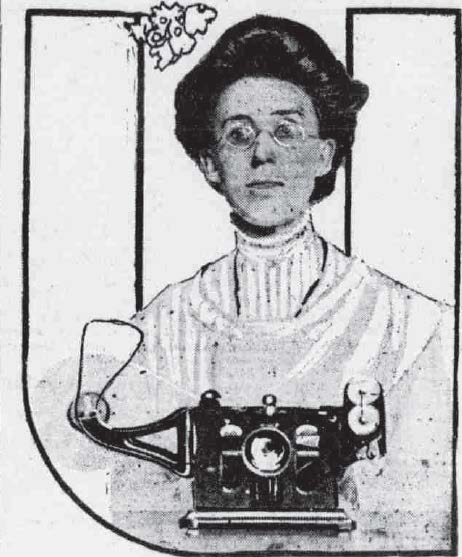
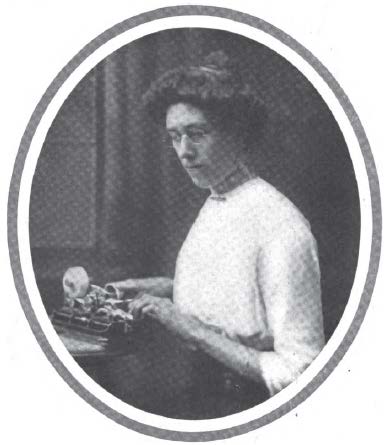
To the many young women who learned to shorthand from her, Miss Grace Keator was something of a heroine. Miss Keator had developed a special machine for taking shorthand notes, which were  then easily transferred onto a typewriter for review and signature.

According to Miss Keator, “We have a machine for taking shorthand notes. It has six keys. These keys punch combinations of dots that take the place of shorthand notes. These dots appear on a narrow paper tape.” To read the dots, the paper strip was unrolled on the secretary’s lap, and used to type the letter on a standard typewriter.  Instruction in how to use the machine could be had, under Miss Keator’s tutelage, at the New York Association for the Blind.

Miss Keator herself had lost nearly all her sight in an illness in the late 1890’s. With her dreams of a career as a literature teacher dashed, Miss Keator learned Braille at Batavia’s Institute for the Blind, and taught herself how to use a typewriter. Her efforts attracted attention, and Miss Winifred Holt hired her on at the New York Association for the Blind as a secretary. Nor was Holt the only one to employ Miss Keator; on a visit to New York City, President Taft heard of the blind secretary, and personally requested that she take shorthand for him.

His attention did much to publicize the work of the Association, and r a fundraising drive raised $100,000 for a new Association building. Located at 111 East 59th Street, New York City, it housed a library, rooftop garden, swimming pool, dorm rooms. In its class rooms, the blind were taught trades, such as carpet weaving, broom making,  chair caning, sewing, and of course, shorthand and typewriting under the tutelage of Miss Keator.  The Association sent out blind teachers to blind students who could not attend classes at the Light House. 200 blind boys and girls were mainstreamed into public schools, assisted by children with good sight especially trained to help them.

“One of our most important branches of the work is the care of those who become blinded through industrial accidents,” Miss Holt told the New York Times.“The other day two Italian laborers at work in one of the shafts for the new aqueduct were blinded by an explosion of dynamite and take to the Presbyterian Hospital. When they leave there, they will have no means of support unless the association takes them in hand and teaches them some trade. This we intend to do, as we have done in any number of similar cases in which the victims of such disasters have been made happy and contented wage earners, even though blind for life.”

What “personalized earrings” really means

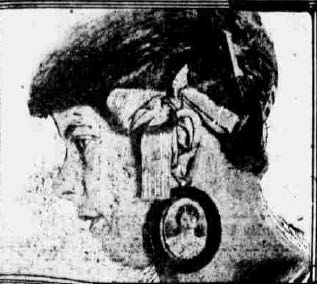
We here at Forgotten Stories have a fashion sense all our own. We’ve worn white on the second Tuesday in September, have and proudly wear a bowler hat, and even pulled off a suspender and belt combo. On occasion our ideas have been known to backfire; we still face the occasional barb for the kilt debacle of 2004 (damn wind). But we’re pretty sure that Dame Fashion, who recycles fashions from the past with reckless abandon, needs to bring this 1921 idea back, a lovely earring, with a picture of a loved one, looped directly over one’s ear.


BABY FEVER!!!

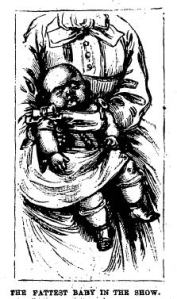
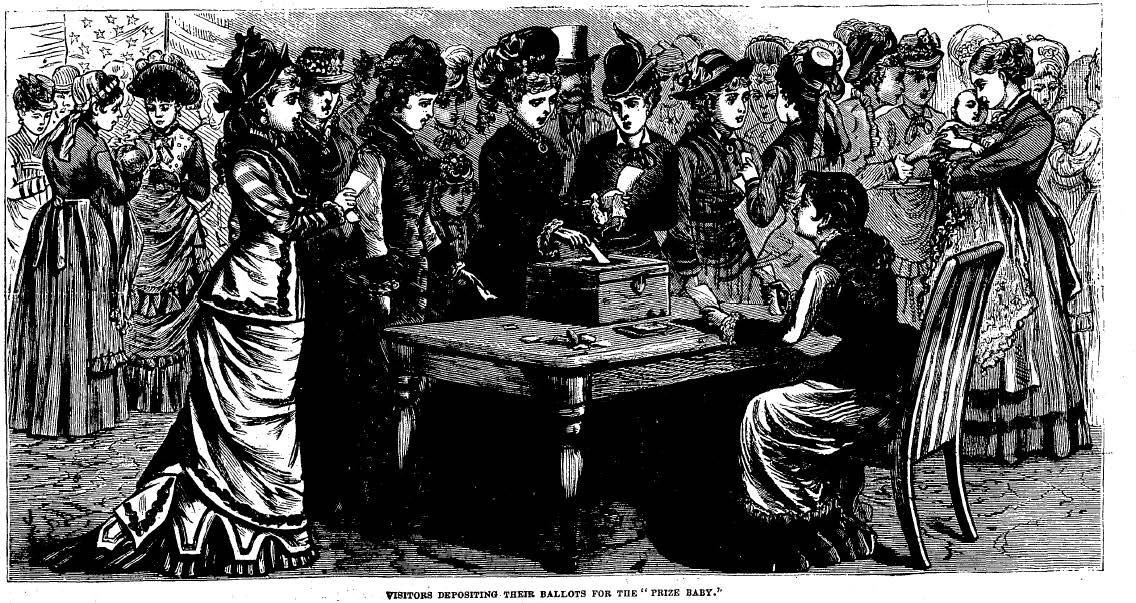
For two weeks in late November 1877, New York caught the baby flu. At Meade’s Midget Hall there were Icelandic babies, Jewish babies, Polish babies, Welsh babies, English babies, Irish babies, one Chinese baby known as Wee Boo, fat babies, skinny babies, homely babies, angelic babies, triplets, phenomena babies, noisy babies, supercilious babies, laughing babies and mostly, crying babies.

Meade, a pale imitation of P.T. Barnum (and all the paler after two weeks listening to infants cry for ten hours a day), was putting on the National Baby Show, wherein mother and child competed for a prizes with a combined worth of a thousand dollars.

Some five hundred mothers lined the walls of the Meade’s Hall, sharing two hundred rocking chairs as spectators examined the small specimens. Upon entrance, each visitor received a ballot, which entitled them to one vote for handsomest mother, prettiest baby, finest triplets, prettiest twins, greatest novelty, prettiest two year old, prettiest four year old, and prettiest five year old. The terrible threes must have been terrible indeed, for their category was omitted.

Above the Exhibition Hall, meals were provided for the mothers, consisting mainly of cold roast beef and mince pie, with a glass of milk. A full time nurse was on-hand. The Society for the Prevention of Cruelty to Children, which had given hints it disapproved of the event, was even invited to provide one of their wards, as an exhibition of a baby neglected and beaten…they declined.

Few fathers were in attendance, but the Brooklyn Eagle managed to secure one for an interview. His infant bore the name George Theodore Franklin Thurlow Washington Rutherford. The father told how his wife strolled the bed chamber with babe in arms; “George Theodore Franklin Thurlow Washington Rutherford, you are mama’s little popsey wapsey woopsey, ain’t you George Theodore Franklin Thurlow Washington Rutherford.” The Eagle’s man, obviously a bachelor, showed enough sensitivity to female sensibilities to wait until the next day’s paper to remark that the baby was so pug-nosed it looked like it had been flattened by a brick.

A few minutes later, a shrill piercing “Henry” went through the Exhibition Hall. Audible even over the crying of five hundred infants, it came from a tall, red-headed woman, pushing her way through the crowd. Another father had been spotted, this one escorting a young lady who was not the mother of the infant on display. The Eagle reporter learned that he’d abandoned mother and son, named Tommy, a few weeks before; he’d had no idea that his child would be on display at the Baby Fair when he went there on a date.

One sweet little cherub with curly hair excited much admiration from the crowd; a young bachelor declared, “If I had such a bright little fellow as that, I should call him George Washington. There’s high physical courage, if ever a pair of eyes told of such a thing. And look at that forehead. There’s true manliness even in babyhood.” A fellow bachelor disagreed; “that boy is no more like George Washington than you are; he’s a young Bonaparte, a short stout determined man…you should call him Napoleon Bonaparte.” The debate, which threatened to devolve into fisticuffs, only ceased when the parties were informed that the mother had already named the child “Mary.”

After “Floory” a blonde haired sweet little girl of two years age started running away with the lead for the votes for the most beautiful baby, competition in the other categories heated up.  Floory’s mother, also blonde, was a lead contender for the most beautiful mother, her fiercest competition was a woman from Albany, who had no baby with her; questioned as to how she could win most beautiful mother, she noted she had a ten year old child upstate.

It was the phenomena babies which earned the most attention. A five month old baby, weighing fifty pounds (a future member of the New York Fat Men’s Association no doubt) was exhibited next to a five week old weighing a scant three pounds. Women flocked around the small thing. There was an toddler that purportedly tried to commit suicide by drowning itself in a bath tub, a child aged thirteen months with no hair or nails, two sets of triplets, a baby who looked like an elf, one who looked like a monkey, a baby who couldn’t stop laughing and the dog baby, who had a long ears and jaw, and barked when he wanted food.

The Eagle’s man didn’t stick around to see who won the various prizes; the sound of screaming infants drove him from the building, and it wasn’t until he was two blocks away that the piercing squalling faded from ear-shot.