The Vast New York Shoe Conspiracy

For years, a vast conspiracy existed between the women of New York and their shoe salesmen. From the doughtiest matron to the slimmest debutante, shoe size 13A or 1 were considered ideal, and anything up to a 3 acceptable; and women struggled to fit into them, much to the consternation of the salesmen.
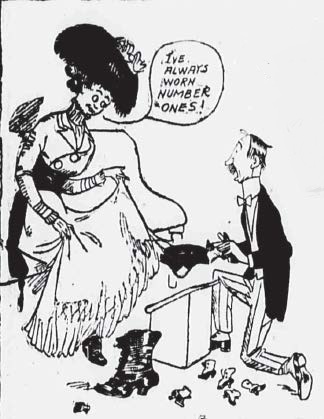
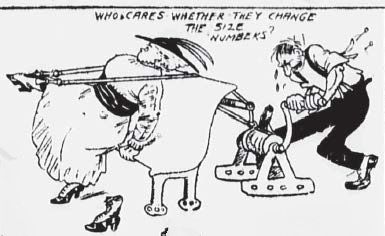
The best conspiracies are the simplest, and footwear specialists came up with a solution; label each and every pair of shoes a 13A or a number 1. The smallest feet around…size 1. Feet like toboggans…size 1. Give the shopper a shoe that fits, label it a size 1, and she’ll be happy.

And so began the legend; “Feminine residents of New York have held to themselves for lo! these many years the flattering belief that they have the smallest feet of the women of any large city. They have prided themselves especially upon their superiority in the matter of small neat tootsies over their sisters of New York’s deadliest rival, Chicago” said the New York World.

Women showed up to buy these:
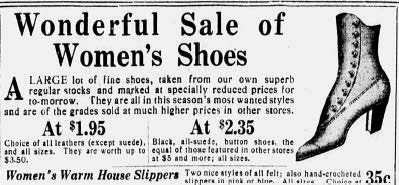
Advertised by retailers such as this (putting on a White Sale during the second week of January 1909):

and all who wanted went home with a size 1 or a 13A.

The charade fell apart during the week of January 13, 1909. First, The National Boot and Shoe Manufacturers’ Association, holding their annual convention at the Hotel Astor, condemned the practice. Association President J. Hanan stated on the record, “The subterfuge ingeniously arranged so a dealer can give a woman any size to fit no matter what she may call for is manifestly unfair.” J.D. Smithers, shoe dealer from Detroit, disagreed, “You tell a lady with a No. 9 foot that you are giving her a No. 9 shoe,” said Mr. Smithers, “and watch her whisk out of your store! What you need in trade young man is discretion.”

Then the other shoe fell (pun completely intended). Mat Grau, theatrical booking agent, was in town to pick out a chorus line for the new Broadway play A Stubborn Cinderella. Advertisements were inserted into newspapers invited the small footed young ladies of the greater New York area to call upon Mr. Grau for an audition; to sweeten the deal Grau offered twice the usual chorus girl salary.
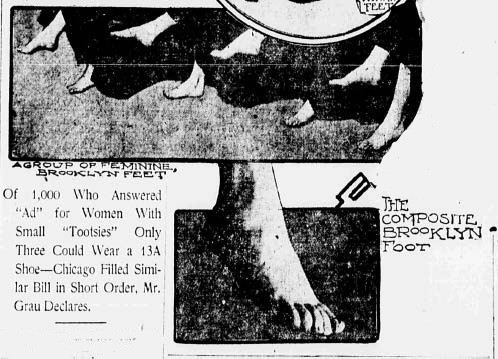
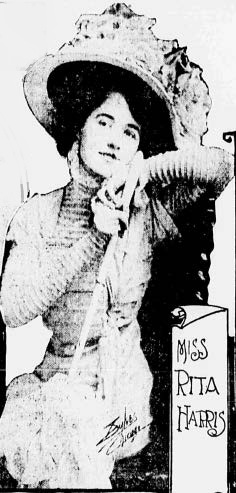
The special nature of the play called for the chorus girls to fill a size 13A shoe. “Out in Chicago, we had no difficulty of a serious nature in picking a chorus of girls – adults – who could wear a 13A shoe” said Grau, and so he expected it to be easy. ” One thousand women came from Newark, Brooklyn, and Manhattan, each trying to squeeze into a size 13A. Said Grau, “Putting [the test shoe] on most of the feet I have run across in a week was like trying to fit a peanut shell on the end of an incandescent lamp.” Grau’s heart fell like a pair of arches with each failure. He’d been testing the feet of chorus girls for years, “I remember the time, when I was younger, that this test shoe I have – a 13A – would slip on the foot of possibly every fifth girl who applied for a chorus position.” But no more. Out of those 1000 women, Grau found only one who could wear the 13A. Miss Rita Harris.
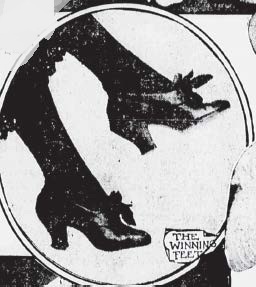
But the illusion was gone; the Achilles heel exposed. The women of New York, Brookyln and Newark had big feet.  And now the world knew it.
The Human Rat Eater of Philadelphia

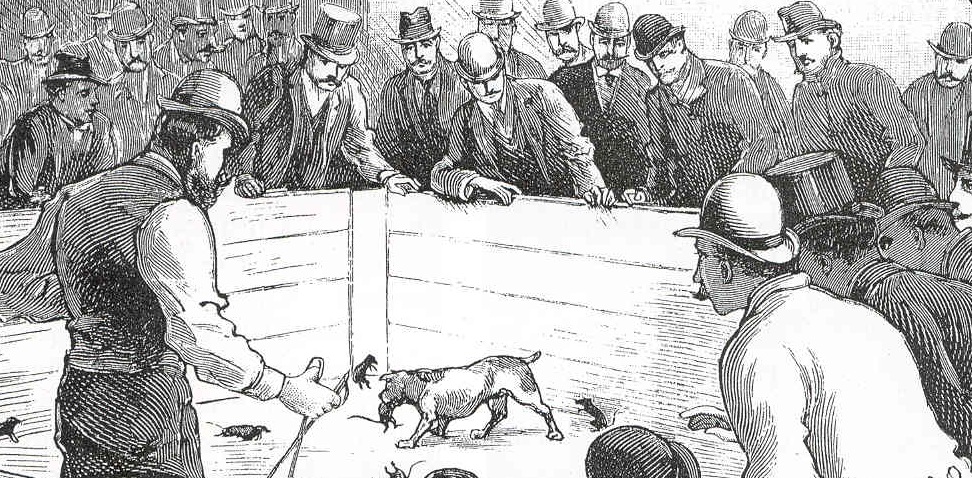
Rat-baiting was popular amongst the denizens of the pool halls and squalid taverns of the urban ghetto.  The sport, if it can be called such, pitted a dog (usually a terrier or a pit-bull) against a ring full of rats; bets would be laid as to how long it would take the dog to kill all the rats, the average time per each rat death, or whether Dog A could kill 50 rats faster than Dog B.

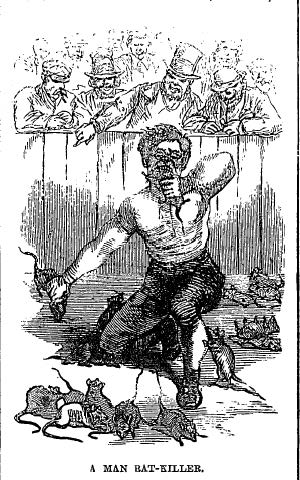
In the dingy squalor of the Philadelphia Pool Hall, according to Frank Leslie’s of December 22nd, 1866, the sport took a new direction. Plain pine board benches were tiered around a center ring, six foot in diameter.  At the center of the ring, full of apologies, stood a man in fighting costume; shorts, with tights underneath for proprieties’ sake, and a loose fighting shirt.  He was sorry, the celebrated canine he had ordered from New York City to fight a pit full of rats had not arrived, but to mollify the crowd he gave them two  options; either he would substitute another dog against the rats, or the crowd could watch him kill the rats personally.  You can guess what the crowd chose.

Some 24 rats, large ones, were brought in; taken from a ship in Philadelphia’s harbor, and dumped into the ring.  As the creatures tried in vain to escape the pit, “The Man Rat Killer” as he is called, set upon them.  Down on one knee, the man plunged his hand into the squirming mass of rats, seizing one, putting it in his mouth, breaking its neck with a squeak and a crunch, before tossing it aside.

After ten or so of their compatriots had been dispatched in such a sundry manner, the rats figured out what was going on, and swarmed, crawling up the man’s thighs, but he was too quick for them. Rat after rat was crushed between the man’s teeth, the last terrified survivor cowering at the edge of the ring, until it too was killed.

The crowd cheered.  The man jumped up, felt his lips which had been bitten once or twice in self defense, pulled some rat hairs from between his teeth, and washed away the taste with a glass of whisky.

I’m not quite sure whether to be disgusted at the cruelty of it, shocked at the fact that he didn’t catch bubonic plague, or to wish that he was still alive today to roam NYC subway stations looking for victims.

Rat Baiting Image from the Police Gazette via Wikipedia.

The Great Female Balloon Race of 1909 – Ms. Miller defeats Ms. Shaffer

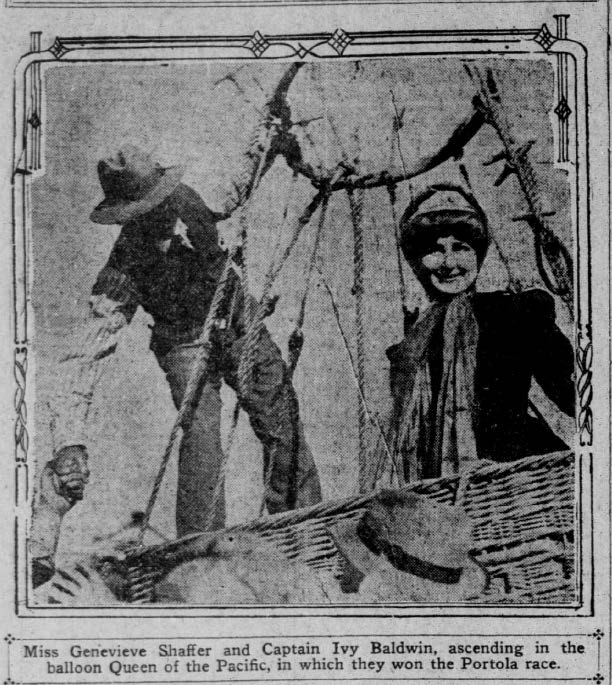
Oakland, California – October 24, 1909 – Ms. Margaret Miller and Ms. Genevieve Schaffer competed for the third time today in an aerial race. It will be remember that Ms. Miller became the first woman to win the Portola Cup, the prize awarded to the balloonist who travelled the farthest from their starting point; and that Ms. Shaffer also has a Portola Cup win to her credit. The two ladies are friendly rivals; Ms. Shaffer’s balloon, Queen of the Pacific, represents San Francisco, and Ms. Miller ascends in The City of Oakland.

Ms. Shaffer, attired in a white veil and a street gown, ascended first. In between snaps of her ever present chewing gum, Ms. Shaffer told reporters, “I am not afraid at all…I have been looking forward to the trip with much pleasure for weeks.” At her signal, her assistant and the builder of the balloon, Baldwin, cut loose the ballast and Ms. Shaffer was away.

With a white handkerchief, Ms. Miller waved a friendly farewell to her rival before climbing aboard The City of Oakland. Ms. Miller too was attired in a simple street dress, beautifully set off by a rose colored veil. Miler is a prominent Oakland society girl, recently returned from New York City where she made a name for herself as a Spanish dancer. Her father, James Miller, well known capitalist and president of the Oakland pottery works, stood by and took many a wager in support of his daughter.

Both aeronauts seemed to find it difficult to discover an air current to carry them forward.  Queen of the Pacific’s captainess preferred to keep her balloon low in altitude in an attempt to discover a sufficient wind. Very slowly Ms. Shaffer’s balloon drifted towards the Bay, and as no life preservers were carried aboard, it was decided to set the Queen of the Pacific down on the Oakland side rather than risk landing in the waters of the Bay. Accordingly, it touched down at Adeline and Fifty-Eighth Street.

Miller adopted a different tactic, ascending as high as 9000 feet, and as a low as 100 feet off the ground in an attempt to find a wind, and risked the waters of San Francisco Bay. When close to the San Francisco shore, a strong wind did come up, directly in the face of Miller, and The City of Oakland was sent backwards towards her namesake city. Coming ashore and landing at the Key Route pier, Ms. Miller had gone the greater distance, and was named the winner.

“I enjoyed every minute of it. I was not nervous and was not afraid at any time,” said Miller. “It is the greatest sport of all to sail in the air.” Miller will be the guest of honor at a sumptuous feast in her honor at a local café.

A Cure for the Common Cold

From the Schulenberg (TX) Sticker of 1909, we learn of a great way to cure the common cold:

“It is an almost infallible cure when…taken properly…Take two ounces of glycerine with eight ounces of good whiskey and add in one half ounce of concentrated pine compound. Take a teaspoonful or tablespoonful every four hours”

So, next time you you have a cold, mix Pine-Sol with Glycerine and Jim Beam, and watch your cold melt away…but look out for the spontaneous combustion side effect.

A Proposed Tee-pee for Central Park

On April 28, 1858, Olmsted and Vaux’s took first place in a design contest for Central Park. In the 1870’s and 1880’s, New Yorkers took great delight in sprinkling monuments and buildings about the Park, like a tree at Christmas. Cleopatra’s Needle was erected in 1877, the American Museum of Natural History was founded in 1868,  the statue of Alexander Hamilton appeared 1880, and that of Fitz-Greene Halleck popped up in 1877, unveiled by none other than Rutherford B. Hayes himself. (We didn’t know who Halleck was either. Go ahead and wiki him. http://en.wikipedia.org/wiki/Fitz-Greene_Halleck We’ll still be here when you get back.)

George Catlin noted the propensity to New Yorkers to decorate their Park. He also knew that he possessed a large collection of American Indian art, developed over years of tramping around the Great Plains sketching and painting the various tribes. It was pretty good art too, Charles Baudelaire stated “Catlin has captured the proud, free character and noble expression of these splendid fellows in a masterful way.” Finally, Catlin was a perennial debtor, and if he could interest New York City in purchasing his pictures, erecting a suitable monument, and hiring him to give lectures,  it would solve his most pressing problems.

And so, Catlin came up with a plan. A gigantic, 75 feet tall teepee would be constructed by the Crow Tribe, and transported to New York by Catlin himself. The upper portion would be painted red, and the lower part yellow, featuring characteristic scenes of life among the tribes “such as buffalo-hunting, dancing, and scalping parties. Beneath this will be a broad band of scalp locks and porcumpine quills. This, as well as an upper and lower band, will be painted red, and furnished with circular windows of ground glass, so colored that their object will not be discovered from without.” Inside, Catlin would place his six hundred paintings of Indian life, to be thoughtfully purchased by New York City.

Perhaps fortunately, the teepee never got built. Catlin’s drawings however did find a home at the Smithsonian, in private collections, and many of his sketches are in the collection of the American Museum of Natural History.

Oh, and here is a painting by Catlin, and Catlin himself:

The Latest in Ballot Box Stuffing Technology

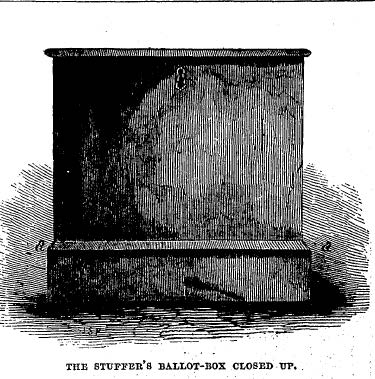
From Frank Leslie’s Illustrated Newspaper of July 19, 1856, comes the latest in malfeasance. No longer are the political insiders’ sole option be to ram a few extra votes in the ballot box and hope that suffices. Technology is on the march, and the call for advances in political chicanery has been answered. And thus we have the latest in ballot box stuffing technology.

Here’s how it works. Your chosen candidate for dog catcher is sure to lose if the people have their way., and we wouldn’t want that. Merely line the side and bottom underneath panels b and d with a few extra ballots marked with your candidate’s name, seal the box after the election, pull out the panels, turn the box upside down, reinsert the panels, turn the box upright and presto, a new dog catcher.


Dictograph in Local Hotel Nabs Crook – Guy Downing Makes His Living Falling Off Trains

Tacoma, Washington, January 24, 1914 – Today Guy Downing, alias James Murray, was sentenced to from one to 15 years for grand larceny. Downing, recently employed as a brakeman on the Northern Pacific Railroad, allegedly fell from a freight car earlier this month, and demanded $750 in compensation.

Although Downing appeared on crutches, Company doctors’ suspicions were aroused when they were unable to find any injuries upon Downing’s person. They reported their concerns to Chief Attorney Quick of the Railroad, who suspected that he had a “personal injury shark” on his hands.  Quick, true to his name, arranged to have a dictograph placed in Downing’s room in a downtown hotel while railroad company agents transcribed any conversation taking place inside the room.

Downing and a companion were caught laughing at his scheme to bilk the company, and to prove that he was suffering no injury, Downing threw down his crutches and put on a boxing demonstration for his friend.

Quick reported the matter to Deputy Prosecutor Askren, who had Downing arrested. Confronted with the evidence against him, Downing confessed to prying the iron handhold loose and throwing himself to the ground. Downing was hauled before Judge Clifford where he pled guilty, and sentenced to the Walla Walla penitentiary, all within a few hours of his arrest.

Said Chief Attorney Quick; “Downing might have gotten away with his claim all right, but he made too much noise. He overplayed his part, and we became suspicious. From my evidence, I am certain he is a professional at this fake claim business, and has worked the same game all over the country.”

True to the end, Downing kept up his act by walking out of the courtroom on crutches.

Robbing Brooklyn Blind[s]

From Frank Leslie’s Illustrated Newspaper of July 26, 1856 we learn of a fantastic little swindle. It seems that the residents at 73 Hicks Street, Brooklyn rented the house from Mr. John Taylor. Around noon, a man drove up in an express wagon, told the residents that Mr. Taylor had sent him over pick up the window blinds, so that they could be repainted. Much pleased with the generosity of their landlord, the tenants helped load up the wagon with every set of blinds in the house. Neither the blinds nor the wagon driver were seen again.

America’s first same sex marriage?

From the Syracuse Standard of May, 1856 we get the story of Albert Guelph, formerly of England. Aged 30, Guelph rented a room from a local Syracuse family named Lewis. When Guelph arrived at the Lewis’ house, he was attired in a dress, but a few days after renting the room changed clothes into blue coat, blue shirt, dark vest and buff colored pantaloons. According to the Standard, the probability is that the family supposed…the’ dress was a disguise, and that [Guelph] was resuming the proper habiliments of her sex.”

Guelph and the Lewis daughter fell in love, engaged in a brief courtship, and were married in the town’s Episcopal Church by the family minister, Rev. Mr. Gregor. It was not until after the marriage that the bride’s father began to suspect that his new son-in-law was really a daughter-in-law; the dress having not quite have done the trick. Mr. Lewis, pere, complained to the police and Guelph was arrested, upon what charge it is not known. As the Standard tells us,  “the bride still clings to her woman husband, and claims that the arrest is a conspiracy against them. They were allowed to meet in one of the ante-rooms of the police office, and embraced each other with the greatest marks of affection.

One wonders what happened to couple.

Machine Guns in the Financial District

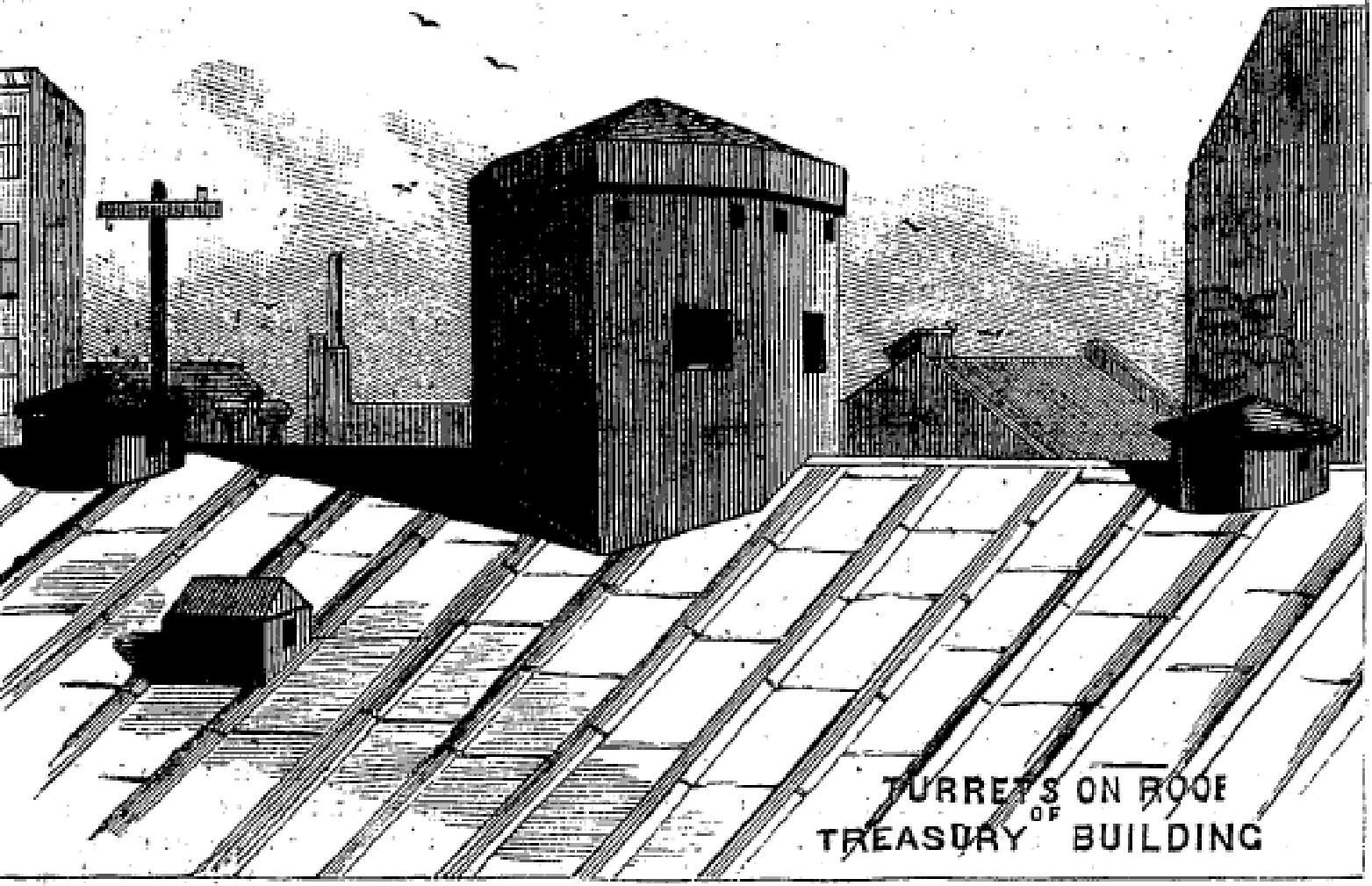
New Yorkers had a troublesome habit of rioting every so often.  They rioted over the price of flour in 1837, over upper class snobbery in 1849, and the draft in 1863.  Just to keep in practice, the police rioted amongst themselves in 1857, in the great New York City Police Riot.  All these riots made the U.S. Government a bit nervous; after all, there were all sorts of money stored in the New York Sub-Treasury building at 26 Wall Street.  So what did Uncle Sam do? He put turrets on the roof, threw a couple of Gatling Guns inside.  To make doubly sure no pesky rioters got close to all that gold, iron shutters were installed, complete with loop holes, through which loyal troops could pick off the masses.

By the way, the Subtreasury building is still there. It is now Federal Hall, with the big statue of Washington out front. Next time you’re there, ask ‘em to let you have a try with the Gatling Guns.

Images from Frank Leslie’s Illustrated Newspaper, April 08, 1881